
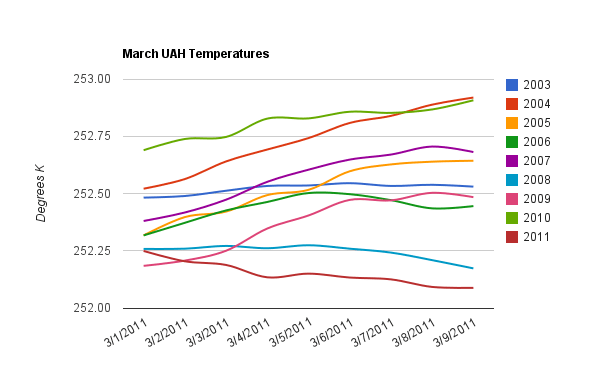
Red circle shows where March is currently sitting.

Red circle shows where March is currently sitting.


 | gelcarrion0t on New Video : Analyzing Oil And… |
 | saveenergy on Is Antarctica Melting? |
| saveenergy on 65 Years Of Progress! |
 | Jeff L. on Analyzing The Western Water Cr… |
 | Morgan Wright on Great Lakes Approaching 100% I… |
| Morgan Wright on Great Lakes Set Another Spring… |
| gelcarrion0t on New Visitech Features |
| saveenergy on Ice-Free Arctic By 2014 |
| gelcarrion0t on Ice-Free Arctic By 2014 |
| gelcarrion0t on Debt-Free US Treasury Forecast |
This is quite a remarkable free fall, but not unlike the one we saw a couple of years ago………..I haven’t seen the health of La Nina lately.
La Nina is fading fast.
Following the end of La Nina, atmospheric temps will fall another 9 months or so?
I too do not understand your point. It is not even as cold as it was two years ago. Your top plot only compares temps to the last 8 years, not 30.
March temperatures are colder than two years ago, and UAH only provides daily data for the last eight years.
0.4C colder than 2 years ago and going down. Global temps normally start rising in March as the Northern Hemisphere with its greater land mass has a bigger seasonal temperature variation than the Southern.
If you check out the UAH data below you will see there has been a sharp drop since the start of the month.
http://discover.itsc.uah.edu/amsutemps/execute.csh?amsutemps
The page at that link is b0rken:
Error!
Error return (1) from MCU_GetPost
30 years is such a short time for determining any trend. If not for the super El Nino spike of 1998 there would be cooling in the last 30 years. But that wouldn’t mean much either since it’s only measured in 1/100ths of a degree.
I don’t mean to be difficult but that certainly isn’t `visually’ intuitive but yes to over the last say 12 years. It will be interesting to see the temperature trends over say the next 10 years,or 20, 0r 30 …… after which I won’t give a #@*&. 🙂
Amino – Indeed. 30 years on an ice core graph barely registers.
Still, it is starting to look like we’ve wasted a lot of CO2 on this warming project.
Check out the SOI index.
http://ioc3.unesco.org/oopc/state_of_the_ocean/atm/soi.php
Mclean etal estimate a 7 month lag between the SOI and global temps. SOI is at a record high. From here I estimate we will drop another 1 degree C. The next panic over global cooling will start and be blamed on gobal warming. Who would guess that this much heat could be lost so fast. If .1 degrees per decade warming translates into 1 watt/meter of radiative imbalance at the top of the atmosphere then 1 degree cooling over six months must be something like 200 watts per meter of cooling.